
 Natural diamond versus lab-grown diamond: a clear comparison
A diamond rarely marks an ordinary moment. It seals a promise, marks a milestone, or gives lasting expression to personality. Those comparing a natural diamond versus a lab-grown diamond therefore look beyond technical characteristics. Origin, rarity, aesthetics, and personal significance also play an important role.
Both are real diamonds. They consist of crystallized carbon and essentially share the same chemical and physical properties. Furthermore, both can exhibit exceptional brilliance. Yet, they tell a fundamentally different story.
For those who choose based on knowledge, taste, and a sense of heritage, the difference lies precisely in that depth.
Natural diamond versus lab-grown diamond: the essential difference
A natural diamond is formed deep within the earth under exceptional pressure and heat. It is then brought to the earth’s surface by rare volcanic processes.
Many natural diamonds are billions of years old. Some dated specimens even formed 3.3 to 3.5 billion years ago. Every stone thus forms a tangible connection to the geological history of our planet. GIA research describes this exceptional origin and age.
A lab-grown diamond, on the other hand, is produced in a controlled environment. Two main techniques exist for this: HPHT and CVD.
HPHT mimics high pressure and high temperature. In CVD, crystallized carbon grows layer by layer on a diamond seed. The growth process typically takes several days to weeks, depending on the method used and the desired size.
The result is not an imitation, cubic zirconia, or moissanite. A lab-grown diamond is a real diamond with virtually the same chemical, physical, and optical properties as a natural diamond. The difference lies primarily in the origin and the growth process.
The choice is therefore not about real versus fake. It is about natural rarity versus technical reproducibility. Some buyers appreciate the modern precision of a lab-grown diamond. Others are drawn to the unrepeatable origin of a natural diamond.
What you see: brilliance, color, and cut
To the naked eye, a high-quality lab-grown diamond is usually indistinguishable from a comparable natural diamond. Both can be clear, vivid, and exceptionally brilliant.
The well-known four Cs remain important characteristics:
- Carat: the carat weight;
- Cut: the cut quality;
- Color: the color grade;
- Clarity: the purity.
Yet, exceptional quality does not begin with a report alone. Two diamonds with the same specifications can look different in reality. Proportions, symmetry, and the position of inclusions influence the play of light. The quality of the polishing also plays an important role.
A beautifully cut diamond catches the light and brings it to life. Fire, brilliance, and contrast ultimately determine the visual personality of the stone.
For an exceptional piece of jewelry, one therefore looks beyond the numbers. The diamond must be in harmony with the design, the setting, and the person wearing it.
A sculptural rose gold ring, for example, requires a different look than a modest solitaire. Champagne-colored, white, and black diamonds each give a different character to gold and skin. That aesthetic judgment can never be fully captured in technical gradations.
A diamond certificate provides clarity
A report from an independent gemmological laboratory describes the characteristics and origin of a diamond. It clearly states whether the stone is natural or lab-grown.
The precise grading method varies by laboratory. IGI documents the four Cs for lab-grown diamonds, among other things. GIA currently uses the categories “Premium” and “Standard” for colorless and near-colorless lab-grown diamonds.
Also ask about any post-growth treatments. In addition, cut quality, symmetry, and polish remain important. A grading report confirms objective characteristics but is not an appraisal or a guarantee of future value.
Furthermore, a report never replaces the trained eye of an experienced diamond dealer. In haute joaillerie, the selection of the stone is also a form of craftsmanship.
Price and value: two different perspectives
Lab-grown diamonds are generally significantly more affordably priced than natural diamonds with comparable characteristics. Production can be scaled and refined. As a result, larger stones have become accessible within a certain budget.
Those primarily seeking size, clarity, and visual impact may consider a piece of jewelry with a lab-grown diamond an attractive choice.
With natural diamonds, rarity plays a larger role. The price is determined by weight, color, clarity, cut, and shape, among other factors. Demand, availability, certification, and exceptional characteristics also influence the value.
Natural diamonds also have a longer-established secondary market. However, this does not mean that every natural diamond is an investment. Value retention can also never be guaranteed. The original retail price is likewise not automatically equal to the later resale value.
For lab-grown diamonds, the secondary market is more limited. Additionally, market prices may fall as production methods become more efficient. You therefore choose a lab-grown diamond primarily for its beauty, size, and the pleasure of wearing it. Expected resale value should rarely be the main argument.
That is not a shortcoming, as long as you make the choice consciously.
Origin and sustainability require nuance
Lab-grown diamonds are regularly presented as a more sustainable alternative. Their production does not require diamond mining, but it does require energy. The actual environmental impact depends on the production method and the energy source used.
Therefore, the word “lab-grown diamond” in itself does not tell the full sustainability story. Transparency about the producer, energy supply, and production location remains important.
The impact of natural diamond mining also varies greatly. Mining method, location, working conditions, and oversight all play a role. Furthermore, diamond mining in certain regions can support employment and economic development.
General statements about “sustainable” or “ethical” are therefore rarely sufficient. Responsible sourcing, monitoring, and traceability offer more clarity.
Those who find sustainability important can ask a few targeted questions:
- Where does the diamond come from?
- What documentation is available?
- Are any treatments mentioned?
- How is the origin verified?
- Is there information about the producer or supply chain?
The lifespan of a piece of jewelry also deserves attention. A carefully crafted piece can be worn for decades. When it is cherished, repaired, and passed on, it gains ever more personal meaning.
Which diamond suits your occasion?
For an engagement ring, anniversary gift, or future family heirloom, many people consciously choose a natural diamond. Not only for its beauty, but also for its age and rarity.
A natural diamond carries a history that far transcends human time. That symbolism possesses a quiet power. Especially in a piece of jewelry that can connect generations.
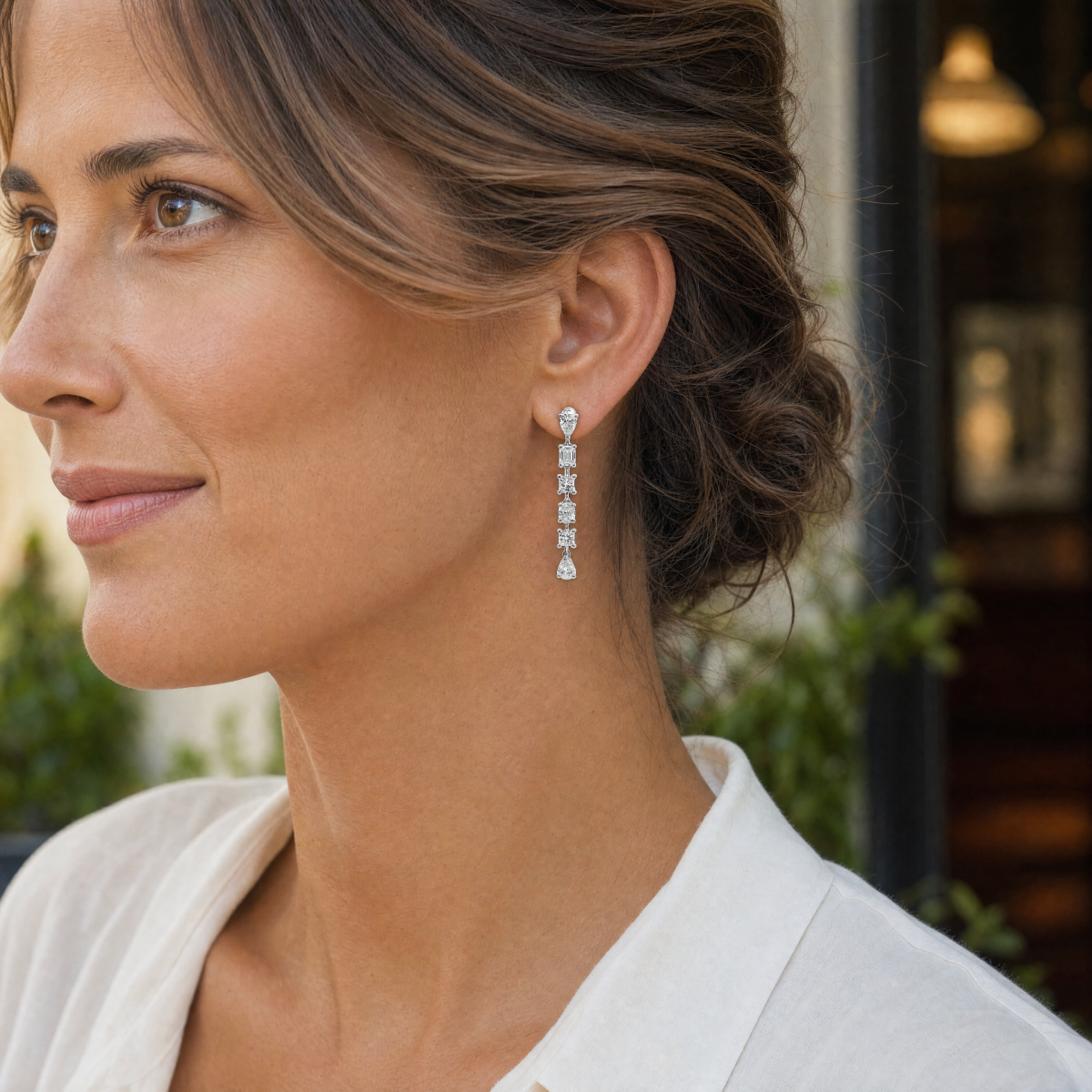
A lab-grown diamond suits those seeking maximum visual impact within a certain budget. This can make a larger or higher-graded stone attainable. This makes it attractive for engagement rings, earrings, cocktail rings, and jewelry for daily use.
A lab-grown diamond can, of course, also represent an important promise. The emotional significance of a piece of jewelry is ultimately determined by the giver and the wearer.
There is therefore no universally correct choice. There is, however, a diamond that aligns with your values, style, and expectations.
Those primarily seeking beauty and design can be guided by the eye. Those who also value natural scarcity, geological origin, and transferability will judge a natural diamond differently.
The selection behind an exceptional piece of jewelry
At JM Asscher, a diamond never stands alone. The stone is assessed in relation to the cut, the setting, and the complete design. Color, proportions, and the play of light must also be in balance with one another.
The largest carat size is not automatically the most beautiful choice. An excellently cut diamond can be more impressive than a larger stone with less vibrancy.
The chosen gold color also influences the result. Rose gold can deepen the warmth of a champagne-colored diamond. White gold emphasizes clarity and contrast. Yellow gold gives a piece of jewelry a classic and rich appearance.
It is precisely that coherence that transforms a beautiful stone into an exceptional piece of jewelry.
Therefore, do not be guided solely by a price difference or technical specifications. Take the time to view diamonds side by side. Pay attention to the play of light and experience how every stone comes to life in the chosen design.
The right diamond is not only beautiful at the moment of purchase. It continues to speak when that moment has become part of your personal history.