
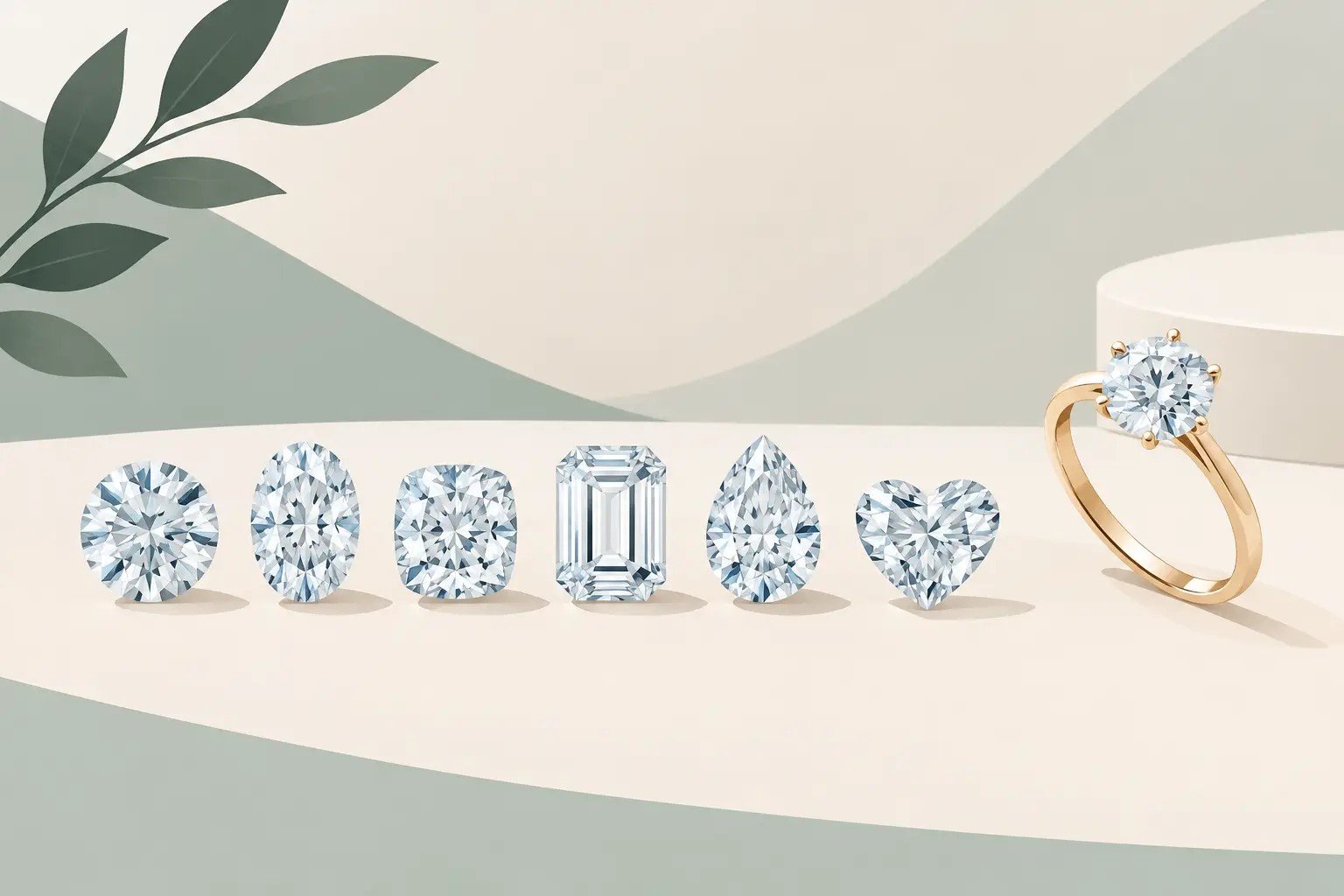
Popular diamond cuts for rings: which cut suits you?
A diamond gains its character not only through carat weight, color, or clarity. The cut determines how light moves through the stone. Furthermore, the shape influences how a ring looks on the hand and the character the piece of jewelry acquires. Those who compare popular diamond cuts for rings are therefore not just choosing a silhouette. You are choosing a personal signature that remains relevant for years to come.
A round brilliant can radiate exceptional liveliness. Conversely, an emerald cut convinces through clarity, tranquility, and architectural precision. The right choice emerges where personal taste, proportion, wearing comfort, and exceptional craftsmanship meet.
Popular diamond cuts for rings and their character
Every diamond cut has its own appearance. Some shapes are developed to create as much brilliance as possible. Others emphasize geometry, transparency, or unique proportions.
Below, you will discover some of the most important cuts and their characteristics.
Round brilliant – maximum brilliance
The round brilliant is among the most beloved diamond cuts in the world. Thanks to the carefully calculated facets, an intense play of light and fire is created.
This shape is classic without becoming predictable. A round diamond, for example, fits perfectly in a solitaire ring. Its brilliance also shows to its full advantage in a refined pavé setting.
Additionally, the round brilliant is particularly versatile. A slender rose gold band gives the ring warmth and softness. White gold or platinum, on the other hand, emphasizes the clear appearance of the diamond.
Its popularity also offers a practical advantage. Round diamonds are relatively widely available. This allows you to accurately compare cut quality, color, clarity, and carat weight.
Oval diamond – refinement and length
An oval diamond combines the liveliness of a brilliant cut with an elegant, elongated silhouette. This allows the stone to optically lengthen the finger.
A well-cut oval diamond can also appear relatively large for its carat weight. This makes this shape attractive for those who wish to combine presence and elegance.
When selecting, the so-called bow-tie effect deserves attention. This creates a dark or shadowy zone in the center of the diamond.
A subtle effect can be inherent to the shape. However, it should not overpower the liveliness of the diamond. Therefore, we prefer not to judge a diamond solely by its certificate. The actual play of light is at least as important.
Emerald cut – understated prestige
The emerald cut speaks a completely different language. Long, parallel facets do not produce an explosion of small flashes of light. Instead, broad reflections are created that are reminiscent of mirrored staircases.
The result is clear, graphic, and distinctly elegant.
This cut demands transparency in the most literal sense. Due to the large open table, inclusions can be more easily visible. The color of the diamond can also emerge more clearly.
Therefore, color, clarity, and especially the individual appearance of the stone deserve special attention.
Those who choose an emerald cut often consciously opt for understated luxury. The beauty lies in the proportions, clear lines, and quality of the diamond.
Cushion cut – soft elegance
A cushion cut combines a square or rectangular silhouette with rounded corners. This creates the characteristic, soft shape from which this cut derives its name.
Cushion cuts can differ significantly from one another. Some are almost square. Others have clearly elongated proportions.
The facet structure also varies. A traditional cushion can show large, calm light reflections. Other variants exhibit a livelier pattern with numerous small reflections.
It is precisely this diversity that makes the cushion interesting. One stone shows to its full advantage in a solitaire ring. Another requires a refined halo or a combination with smaller diamonds.
Asscher cut – heritage in geometry
The Asscher cut has a square base, cropped corners, and a characteristic stepped facet structure.
The geometry is often associated with the refined design language of the Art Deco period. Yet, a well-designed ring with an Asscher-cut diamond feels distinctly modern even today.
Unlike a round brilliant, this is not about maximum sparkle. The beauty is created by symmetry, depth, and clear light reflections. The stepped facets can create a fascinating optical effect often described as a hall of mirrors.
For JM Asscher, this cut also holds a special significance. The name Asscher is closely linked to the history of the diamond industry and the development of this characteristic cut.
Therefore, within our world, the Asscher cut represents more than just aesthetics. It connects geometric precision with an exceptional diamond history.
Princess cut – modern geometry
The princess cut typically has a square shape and is known for its lively brilliance. The sharp corners provide a modern and graphic silhouette.
This makes the shape interesting for those who appreciate the look of a brilliant cut but seek a more geometric diamond.
The corners of a princess cut deserve extra protection. An expertly designed setting helps protect these vulnerable points during daily wear.
The quality of the cut is also important. A carefully selected princess cut maintains an attractive play of light from various viewing angles.
Pear and marquise – distinct elegance
A pear-shaped diamond combines a rounded side with an elegant point. Set vertically, this shape can optically lengthen the hand. Worn horizontally, the same diamond takes on a surprisingly contemporary character.
The marquise is even more pronounced. Its elongated silhouette and two fine points create a strong visual presence.
For both shapes, the setting must protect the points well. Additionally, just as with an oval diamond, a bow-tie effect may be visible.
Therefore, the individual assessment of the stone remains important. No two diamonds behave exactly the same in the light.
Which diamond cut suits your hand?
The right cut does not need to correct your hand. However, a certain shape can enhance a visual effect.
Elongated diamond cuts such as oval, emerald, pear, and marquise often create a sense of length. Conversely, round, cushion, and Asscher diamonds form a powerful and balanced centerpiece.
The width of the ring band also plays a role. A fine band places more emphasis on the central diamond. A wider or sculptural ring band gives the overall design more presence.
That is why at JM Asscher, we do not look exclusively at the diamond. The relationship between stone, setting, metal, and hand ultimately determines the character of the ring.
Consider daily wearing comfort
A diamond ring should not only be beautiful. Especially when you wear it daily, comfort and protection are important.
Round and oval shapes do not have distinctly sharp corners. With princess, pear, and marquise-cut diamonds, the protection of the points requires extra attention.
An expertly designed setting can make a significant difference in this regard.
True luxury, after all, is not just in what you see. It is also in the confidence that a piece of jewelry has been carefully designed to be worn for years.
Why the cut quality of a diamond is important
Two diamonds with the same shape and carat weight can look completely different.
This difference arises, among other things, from their proportions, symmetry, and polish. These factors influence the way light moves through the diamond and returns to the eye.
In brilliant cuts, the emphasis is often on brilliance and scintillation. In step-cut shapes, such as emerald and Asscher, regularity, transparency, and broad light reflections are key characteristics.
Larger, therefore, does not automatically mean more impressive.
An exceptionally cut diamond with balanced proportions can have a presence that can hardly be expressed in millimeters or carat weight.
The diamond and the setting form a single whole
The setting also changes the character of a diamond.
A solitaire ring gives the central stone maximum space. A halo of smaller diamonds can add extra sparkle and make the central diamond appear visually larger.
A three-stone ring creates yet another balance. In this case, the mutual proportions of the diamonds play an important role.
There is, therefore, no universally best design. It is about the coherence between diamond, setting, material, and personal style.
Choose a diamond cut with lasting significance
Trends can inspire, but a diamond ring deserves a choice that goes beyond the moment.
An oval diamond may appeal for its soft elegance. An emerald cut might convince through its understated geometry. An Asscher cut, on the other hand, draws attention through depth, symmetry, and heritage.
Therefore, take the time to view different popular diamond cuts for rings side by side. Preferably do this in various lighting conditions.
Do not only notice the initial sparkle. Also look at the proportions, the comfort on your hand, and the character that remains visible when you look at the stone for longer.
At JM Asscher, we believe that a special diamond is not chosen solely based on numbers. The most beautiful cut is ultimately the shape in which beauty, craftsmanship, and personality converge.